

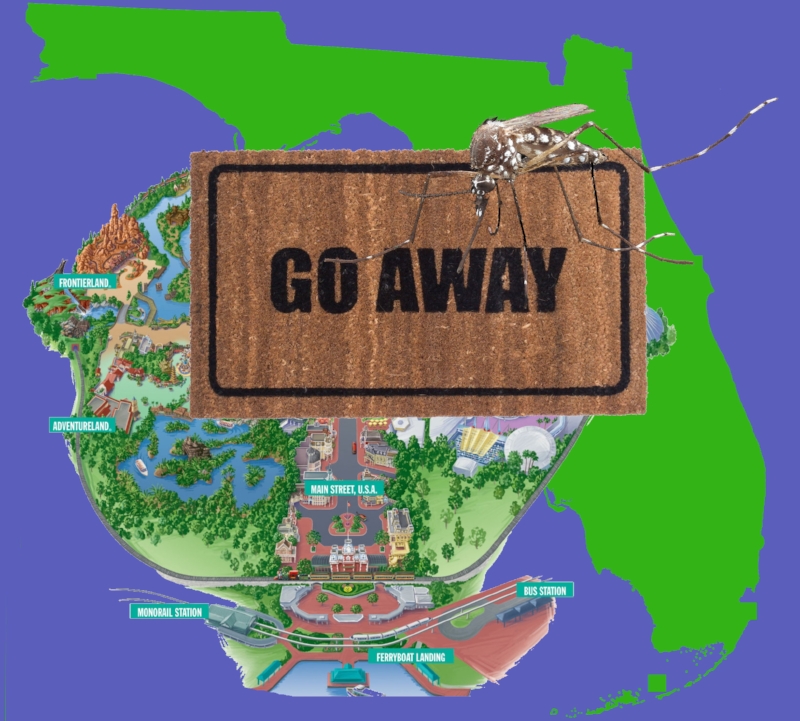
Planning a vacation to sunny Florida and our favorite theme park requires some strategic planning in light of the war against Zika. But with a little battlefield intelligence and some smart tactics, you can safely enjoy a stress free holiday in the Magic Kingdom.
Chikungunya, Dengue, and Malaria... Florida's historic battles with the mosquito have become as legendary as the names Olustee Battlefield and the Castillo de San Marcos. Dengue was identified as the cause of serious illness as far back as 1780. Sporadic outbreaks of Dengue and the typical Dengue Fever symptoms continued all the way through the 1900s, sometimes involving thousands of infected. In response to Dengue, yellow fever, and malaria threats around the world, world health organizations developed a united eradication effort for the Ae. aegypti mosquito, the most common carrier. They made the Aedes aegypti mosquito enemy number one. Efforts included spraying DDT, monitoring for outbreaks, draining potential breeding places, and educating the public. The effort initially paid off, but it wasn't long before nationalistic squabbling and public indifference resulted in a failure of the program. As mosquito populations swelled again, the diseases associated with them returned with a vengeance, and diseases not previously well known hitched a ride in Aedes mosquitoes as they stowed away in modern ships and planes. Enter the Zika virus in Florida.
A major outbreak of what was believed to be Dengue fever hit several port cities in the US and Mexico including Pensacola, Florida in 1827. Review of the symptoms though, seems to indicate another, less well known disease carried by mosquitoes, Chikungunya. For many years, no one credited this virus, and it remained in relative obscurity to most North Americans. Still, Chikungunya was the relative newcomer in the US and Canada until recently, the newly blooded veteran among the old guard. But today, a new recruit is proving even more aggressive than Chikungunya. Initially imported from Asia and Africa, it has spread throughout the Southern Americas, and the first verified case of domestic transmission from home grown mosquitoes in the USA occurred in 2015, in beautiful, touristy Miami. Chikungunya was quickly added to the state's monitoring program, but all in all, only about BLANK domestic cases have been reported thus far. The relative paucity of cases thanks in part to the monitoring and eradication efforts of Floridians. Florida had become adept at recognizing and dealing with new mosquito borne diseases. So most people in the tourism industry have been pretty optimistic that they are ready to defend against the newest smart weapon in the mosquito's arsenal, Zika.
What is Zika?
Zika is an arbovirus, or a virus spread by an arthropod, in this case, mosquitoes. The mosquitoes that spread Zika to humans are the Aedes mosquitoes, Aedes Aegypti or Albopictus, mostly Aegypti. It can also be spread by sex with someone infected, or from mother to fetus. It has not been found to pass via breast milk. This isn't a new disease. It's been around for a long time in Asia and was first diagnosed in humans in 1952. With increasing air and ocean travel, mosquitoes and people infected with Zika traveled to South America and then to North America. When it was limited to Asia, it was considered more of an annoyance disease. Most people reported symptoms that were relatively mild and short lasting with no known permanent disability.
According to the CDC, the most common symptoms are fever, a rash, joint pain, and redness of the eyes (or conjunctivitis). Some people might also have muscle pain and headache. Even though the symptoms can last for as long as a week, usually they are relatively mild and don't require hospitalization. It's very rare that death results, and when it does, it is usually in people who have another disease at the same time, like AIDS or chikungunya. There is currently no cure, treatment, or vaccine for Zika. However, a vaccine is currently in development. There is also no commercially available test, so fluid samples have to be sent to one of the specialized labs that are currently able to run the tests to properly diagnose Zika in people who demonstrate the symptoms.
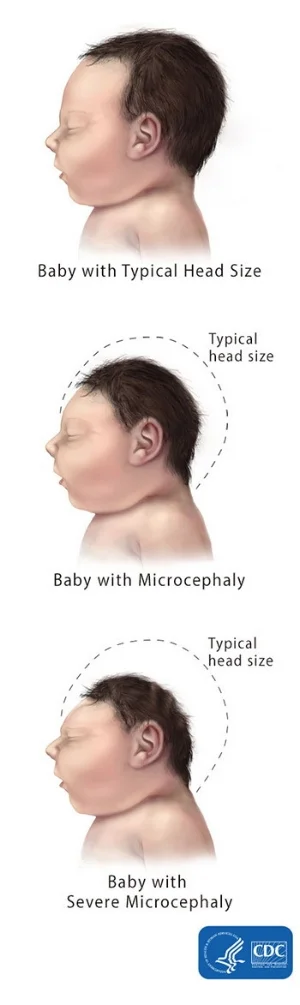
Unfortunately, since it made the leap to South America, a new problem has been identified, mostly in Brazilian cases. Pregnant women who become infected with Zika have given birth to babies with very small brains, a condition known as microcephaly. (Micro=very small, and cephaly=of the head or brain.) In Brazil the number of microcepahlic infants born has become epidemic, and many fear that the US could face a similar problem if Zika infected mosquitoes are allowed to breed here. Babies with microcepahly don't just have small heads. Their brains fail to develop, and the skull develops to fit around it. This means these infants have greatly reduced capacity to grow and develop. Most won't make it into adulthood at all, and those that do will need lifelong assistance to live. Not only is this a human tragedy of lost potential and decreased quality of life, but it creates an enormous financial burden on the family and society as these children will never be able to support themselves and will require expensive medical intervention throughout their lives.
In some other cases women have had miscarriages as a result of the infection. Another problem identified is the development of Guillain-Barre syndrome. Researchers are still investigating what other long term health effects might be linked to prenatal exposure to Zika.
Why is the prevalence of birth defects only now being linked to Zika? Even though this problem wasn't identified in the past, scientists don't know yet if it is due to the fact that the disease has mutated, or if perhaps it was always likely to cause birth defects and miscarriage, but was being under reported. There could be still other explanations for this apparent change in outcomes. This is a rapidly developing situation, currently under intense study, and even by the time I've finished writing this article, new developments may have come to light.
What is Florida doing?
Zika has arrived in force in Puerto Rico, with over 22,000 cases reported already in 2016. There, the problem is immediate and severe. So far though, the mainland of the continental US states have been mostly spared. But states like Florida, Louisiana, Texas, and South Carolina offer perfect breeding grounds for the main culprit, the Aedes mosquito. You may have heard about some people in the US who have been infected by Zika. Most of these cases are people who were traveling outside the US and returned home with the virus. However, there have been forty-three cases of local transmission from mosquitoes in Florida. That means a person is bitten by a mosquito here in the US and becomes infected. These local cases have all been in the Miami-Dade area in Florida. The CDC has issued guidance for people planning to visit these areas. As of this writing, it is recommended that pregnant women and their sexual partners should not visit Miami. However, you should check the CDC website for the most up to date information when planning your visit. Zika has not been found in any other area of Florida so far.
The most effective way to stop Zika, at least for now, is to stop its transmission. So Florida has initiated a program to do just that, and it has lots of components all of which work together to help reduce the spread of diseases like Dengue Fever, Malaria, Yellow Fever, and Zika. The governor has allocated $25 million in addition to the money so far granted by Congress for the battle against Zika. This is only a fraction of the total amount the CDC estimates is needed to complete the job, but it's a good start.
One of the most visible efforts the state makes to control mosquitoes is the spraying of insecticides to reduce the overall mosquito population.
According to the Washington Post,
...the state’s agriculture commissioner issued a mosquito declaration that triggers aggressive mosquito control efforts within a 200-yard radius of the homes of the patients with locally acquired cases.
Unfortunately, some mosquitoes have proven to be resistant to the modern safe pesticides currently in use like permethrin and malathion. In the past, some mosquitoes also showed resistance to DDT. So current requirements are for the use of two or more pesticides at once, a sprayed adult pesticide, and a larvicide, so that those that are resistant to one kind are knocked down by the other, and vice versa. So far, this method seems to be working in Miami, Florida.
Pesticides are just one part of the solution. The Florida Department of Environmental Protection, State Parks and Recreation, Florida Fish and Wildlife, and many other state agencies help to protect and maintain Florida's largest anti-Aedes mosquito prevention... their extensive wetlands. Many people believe that where there is water, there are mosquitoes. And to some extent that is true, but the kind of body of water determines the species of mosquitoes and other insects that will live there. And many creatures in the wetlands help to keep the mosquito population down. Fish, frogs, birds, and bats are among the natural predators of mosquitoes and these all live in Florida's natural habitats.
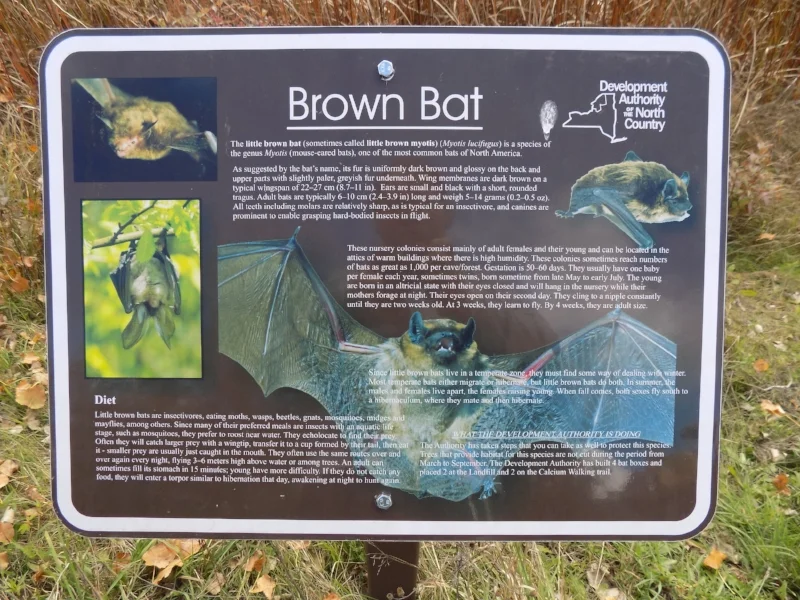
A brown bat information sign in upstate New York. Brown bats are the most common bats in the US and are insectivorous.
Florida has become a haven for bats, and that's another part, albeit not the largest part, of their war on mosquitoes. Bat boxes provide bats, that would otherwise be a nuisance, a place to live near humans without invading their homes. Not all bats eat mosquitoes, of course. But in Florida, there are plenty of species of bat that do and bat boxes have become ubiquitous in some counties.
An entomologist (bug scientist for us non-science folks) at the North Carolina State University, Michael Reiskind is credited with leading the development of a tool to track mosquito bites through a cell phone app called Mosquito Byte! That's important because scientists need to track concentrations of mosquitoes that bite humans, and without enough observers in the field to cover every corner of the state, individual citizens' bite reports fill in the blanks.
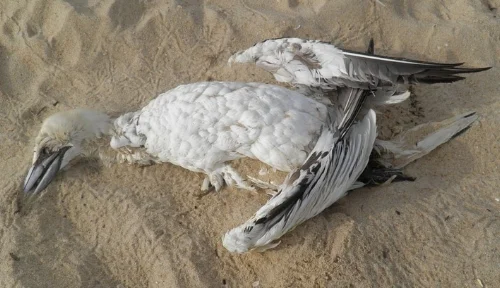
Another kind of observation program involves the use of sentinel animals, including chickens, horses, and even pets. Sentinel animals are normal, healthy animals that are kept in various spots around the state and are monitored by county mosquito commissions. On a regular schedule they test the blood of the sentinel animals to find out if there are any antibodies for various arboviruses such as chikungunya or equine encephalitis. The animals aren't hurt beyond the blood tests and are kept well fed. They don't necessarily get the diseases, but they do get bitten by the same mosquitoes and develop antibodies to them. That means they are the perfect early warning sign that infected mosquitoes are in the area. It's not foolproof, of course. And it has its limitations. But sentinel animals fill a valuable role in the overall surveillance efforts. In addition, the state monitors dead birds, and keeps a count of each, and their causes of death. Birds that feed on insect populations or are infested with mites or bitten by bugs may be among the first victims of insect borne disease outbreaks. They are, in a real sense, the canary in the coal mine.
The Florida Department of Health has created a hotline for getting more information about Zika. Zika Virus Information Hotline Now Available 24/7. Call 855-622-6735. And they are working to produce a variety of announcements to get the word out about personal protective measures such as insecticide use and other self-care.
In an abundance of caution, we are taking additional measures and preventative efforts throughout our property, including providing complimentary insect repellent for Guests and Cast Members. (emphasis added)
But ok, that's not the whole story. Of course it isn't! The Florida Department of Health has so far not reported any cases of active transmissions of the Zika virus in the Orlando area and counties surrounding Walt Disney World Resort. (Visit Florida Department of Health for up-to-date information.)
Remember those sentinel animals? Well some of them are stationed on Disney property, keeping vigil in the back properties and little traveled areas of the park. So far, none of the WDW chickens have tested positive for Zika, so that's the good news! There have been a handful of horses who have tested positive, but so far, no people, and no captured mosquitoes. It's a relief just to know the Disney folks are assisting in this effort and monitoring the situation so we'll have the most up to date data possible.

Terrific article here on River Country with a few pictures of the sentinel chickens in their WDW home.
While we're at it, let's talk about those bats. While I was researching this article, I discovered that Disney cooperates with local universities to study nature on the property surrounding their parks. One of their folks, UCF graduate student and Conservancy intern Laura Seckbach-Finn ended up writing her thesis on big eared bats that were discovered living in an old trailer sitting on Universal Studio land adjacent to Disney Conservation property. Two parks cooperating to conserve bats! Who would have imagined it? And that grad student? She's the young woman who began the push to bring bat boxes back to Florida for the benefit of humans and bats. So, that just goes to show you never know where your college course work is likely to lead you later in life. Big eared bats mostly eat moths and larger insects, but many other bats live on Disney property, and they eat lots of mosquitoes.
Some people have asked why Walt Disney World and other theme parks and resorts in the area haven't adjusted their hours and closed pools as they did during the encephalitis outbreak a few years ago. In fact, Disney's Animal Kingdom has continued to push its after dark operations in preparation for the opening of its Avatar themed land next year. What gives? Well, that virus was carried by mosquitoes with slightly different dining habits. Those mosquitoes are mostly active at night, but the Aedes aegypti mosquito bites during the day, as well as at night. Changing park hours wouldn't help much, and would only inconvenience park goers. Back in the late 90s, when the encephalitis outbreak was in full swing, people probably didn't realize there were different kinds of mosquitoes. But the good news is, Ae. Aegypti also doesn't live in the swamps surrounding Walt Disney World. It likes people habitats and is much more likely to dwell in densely populated areas with lots of little water containers it can leave its larvae in. That's why Miami has been hit so hard. They are a densely populated area in a warm coastal region, with lots of breeding places, especially around all the new home development and building sites. Cleaning up those sites will do a lot to reduce the mosquito population. Entemologists who study mosquitoes say they don't fly far from their breeding area, so outbreaks tend to be localized to a few square miles if people take care not to move those breeding containers for them. So, while Miami has been hit lately, that doesn't mean the next county over will be.

Disney's Port Orleans Riverside seen from the water - Author's collection
That doesn't mean WDW, like other resorts and theme parks in Florida, is not well aware of the mosquito problem and doing all they can to deal with it. They regularly spray insecticides and apply larvicides to potential breeding grounds, but so far, they have not announced any increase or change to longstanding procedures. There seems to be a reluctance to even talk about spraying insecticide or using larvicide in large bodies of water because of the potential damage to local ecology and public fears, often unfounded, of "toxic" pesticides. I sure hope the reluctance to announce this action does not interfere with effective mosquito control. It hasn't in the past, so I am encouraged by the way everyone has worked together during past outbreaks. Of course they are handing out free bug repellent at Disney Springs and their resorts.
There are some other ways to stop mosquitoes, though not on as grand a scale. Simple mechanical traps can be employed, especially near guest areas where spraying might be difficult or unwelcome. Electric zappers are not as efficient against mosquitoes as they are against larger insects, but they can be employed in outdoor seating areas. Certainly the singing of frogs and birds everywhere on the property is a welcome sound, given the proven bug busters' dietary preferences. The Disney resorts' best weapons though, are the amenities guests find most welcome, cleanliness, attention to detail, air conditioning and climate controlled buildings, and education. These are the things Disney does best. Making sure employees, especially Mousekeeping and maintenance workers, at every level know what to be on the lookout for and encouraging them to take action can eliminate or drain many of those breeding containers like trash piles, flower pots, gutters, and old food containers.
What should we do?
You can do probably the most by helping to get rid of mosquito breeding areas in and around your home or property, and around your community. Empty water containers, clean gutters, drain pools, winterize your fountains and clean bird baths. Getting rid of standing water is very important to interrupt the breeding cycle. If you have fountains or other containers that stay full, try using anti-mosquito insecticide disks made specifically for them. Most home made remedies don't work as effectively. Old tires are some of the most frequent habitats for mosquito larvae, so make sure you get rid of any old tires. If you use them to ring trees, in play areas, or for other purposes, drill holes near the bottom so any water that gets in them can run back out, and check them from time to time. Don't over water plants, lawns, and gardens. If you'd like to do even more to help prevent Zika, write a letter to your congressperson and urge them to fully fund Zika research and prevention efforts. You can also download this free app to report your mosquito bites in real time!
Most importantly, don't panic, but arm yourself with knowledge. If you've already planned your Disney vacation, there's probably no reason to change your plans. Disney is doing its part to reduce your risk, and so is the state of Florida. But the risk is not zero for pregnant women or those who are considering having a child in the next few months. You'll want to check the CDC's website for the most up to date information. Once you've made sure no new cautions, alerts, or warnings have been issued, follow the advice provided on the CDC and Florida Department of Health's websites.

There are tons of fun things to do both at Walt Disney World and elsewhere in Florida that do not require you to be outdoors. If you are pregnant, planning to be, or just want to be extra cautious, look into lists of indoor attractions. In the parks you can enjoy indoor rides like the Carousel of Progress and Pirates of the Caribbean, Frozen, or Toy Story, Midway Mania. In Disney Springs (the former Downtown Disney area) you can take in a movie, shop, or enjoy lots of delicious food, all while barely stepping outside. And don't forget the entertainment at the resorts. Treat yourself to a spa day, try out the arcade, shop the gift shop, try some of the best restaurants on property, or learn how to cook with Chef Mickey. You can even watch the fireworks from inside some restaurants! Check out Two Grumpy People's new video for more ideas.
